

Slope Formula

Lesson Objective
This lesson shows you how the slope formula is derived and some examples on using the formula.

About This Lesson
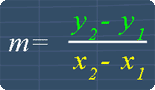
After defining the slope of a line as the ratio of the 'change in y' and 'change in x', we can use this definition to derive the slope formula.
This lesson will show you the steps to derive this formula. Also, you will able to see some examples on using this formula.
You should proceed by reading the study tips and watch the math video below. After that, you can try out the practice questions.
Study Tips

Tip #1
Understand how the 'change in y' and 'change in x' are calculated. To recall them, you can watch the first math video in the slope of a line lesson.
Tip #2
It is important to understand the slope formula before using it. You will be more comfortable with the formula once you have understood it.
Now, watch the following math video to learn more.
Math Video
Click play to watch video
Sponsored Links
| |

You can contribute to the development of this site and keep it free by getting all six video lessons and volume of solids and calculator app for just US$1.99 from Apple App Store.
I'd like to contribute or to know more about the app
Math Video Transcript
00:00:01.110
In this lesson, we will learn how to derive and use the slope formula.
00:00:06.190
From the previous lesson, we learn that the slope of a line is equals to, 'change in y' divides by 'change in x'.
00:00:14.160
Using this definition, we can now derive the slope formula.
00:00:19.210
Let's put the first point on the coordinate plane.
00:00:23.150
Now,since we are deriving a formula, we can represent the x-coordinate and y-coordinate as x1, and y1 respectively.
00:00:33.070
Let's put the second point on the plane.
00:00:37.130
Again, we can represent the x-coordinate and y-coordinate as x2, and y2 respectively.
00:00:44.110
Now, with these two points, we can draw a straight line and derive the slope formula from here.
00:00:51.230
Now, imagine that we run from, x1 to x2. The change in x would be x2 minus x1.
00:01:02.050
Alright, with this, we can replace 'change in x' with 'x2 minus x1'.
00:01:08.220
Next, referring to the y-coordinates, when we climb up from here, the "change in y" will be, y2 minus y1.
00:01:19.070
Now, with this, we can replace 'change in y' with 'y2 minus y1'.
00:01:26.120
Finally, the slope is equals to, "y2 minus y1" divides by "x2 minus x1".
00:01:34.130
Following the convention, we can represent the slope with the variable m.
00:01:40.190
So, we now have the slope formula, m equals to, "y2 minus y1" divides by "x2 minus x1".
00:01:49.240
Alright, let's use this formula to find the slope of this line.
00:01:55.190
Let's view the actual coordinates for the first point. we have, x1 as 2.0, and y1 as 3.0.
00:02:05.060
Similarly, for the second point, we have x2 as 5.0, and y2 as 6.0.
00:02:13.180
Now, we can find the slope of this line by simply substituting these coordinates into the slope formula.
00:02:20.180
Let me show you, substituting y2 with 6, y1 with 3, x2 with 5, and x1 with 2.
00:02:36.010
Now, we can see that we do not need these brackets. So, let's remove them.
00:02:42.020
Let's simplify this, negative multiply by bracket 3.0 gives negative 3.0.
00:02:49.060
Negative multiply by bracket 2.0 gives negative 2.0.
00:02:54.160
6.0 minus 3.0 gives positive 3.0. 5.0 minus 2.0 gives positive 3.0.
00:03:04.120
Now, positive 3 divides by positive 3 gives positive 1.
00:03:09.220
So, the slope of this line is positive 1.
00:03:15.100
Let's take a look at another example. But first, let me change the coordinates of these points.
00:03:24.100
Using this formula, we can substitute y2 with 4.0, y1 with negative 1.0, x2 with 1.0, and x1 with 6.0.
00:03:40.130
Now, we can see that we do not need these brackets. So, let's remove them.
00:03:46.170
Let's simplify this, negative multiply by bracket negative 1.0 gives positive 1.0
00:03:54.080
Negative multiply by bracket 6.0 gives negative 6.0.
00:03:59.240
4.0 plus 1.0 gives positive 5. 1.0 minus 6.0 gives negative 5.
00:04:09.130
Now, positive 5.0 divides by negative 5.0 gives negative 1.
00:04:17.050
So, the slope of this line is negative 1.
00:04:21.200
That's all for this lesson, try out the practice question to test your understanding.
Practice Questions & More

Multiple Choice Questions (MCQ)
Now, let's try some MCQ questions to understand this lesson better.
You can start by going through the series of questions on slope formula or pick your choice of question below.
- Question 1 on using the slope formula

Site-Search and Q&A Library
Please feel free to visit the Q&A Library. You can read the Q&As listed in any of the available categories such as Algebra, Graphs, Exponents and more. Also, you can submit math question, share or give comments there.
