

Solving Linear Equations - Part 2

Lesson Objective
This lesson shows you some examples on solving linear equations. These examples will help in your understanding on this topic.

About This Lesson
This lesson is a continuation from Part 1 for this topic.
After learning the basic concepts behind solving linear equations, it is time to take a look at some examples to understand these concepts better.
Study Tips

Tip #1
Remember that when we solve a linear equation, whatever terms that are added to one side of the equation, the same terms must be added to the other side of the equation.
This is important to keep the equation balanced.
Tip #2
When we multiply both sides of the equation, it is important to multiply 'all' the terms in the equation. For example, when we multiply the following equation with 3:
2x + 1 = 4x -8
The equation becomes:
3(2x +1) = 3(4x -8)
Notice that, we put brackets around all the terms to both sides of the equation. By doing so, the equation will remain balanced.
Tip #3
Similarly, when we divide both sides of the equation, it is important to divide all the terms in the equation. For example, when we divide the following equation with 3:
2x + 1 = 4x -8
The equation becomes:
(2x +1)/3 = (4x -8)/3
Notice that, we need put brackets around all the terms to both sides of the equation. By doing so, the equation can remain balanced.
Now, watch the following math video to know more.
Math Video
Video on Solving Linear Equations
Sponsored Links
| |

You can contribute to the development of this site and keep it free by getting all six video lessons and volume of solids and calculator app for just US$1.99 from Apple App Store.
I'd like to contribute or to know more about the app
Math Video Transcript
00:00:01.050
This lesson shows you some examples on solving linear equations.
00:00:05.230
To solve a linear equation, our objective is to find what value x is equals to.
00:00:12.080
Now, Let's solve, 2x -1 = 5 + 4x.
00:00:18.160
Since our objective is to find what is x equals to. we need to put all the terms with x, on on one side of the equation, usually, on the Left hand side.
00:00:29.050
We can do so by removing +4x. To do so, we add -4x to both sides of the equation.
00:00:41.040
The equation now becomes 2x -1 -4x = 5.
00:00:47.220
Now, notice that we also need to remove negative 1? To do so, we add +1 to both sides of the equation.
00:00:59.130
The equation becomes 2x -4x = 5 + 1.
00:01:05.110
Alright, we now add the like terms together.
00:01:09.230
Adding 2x with -4x gives -2x.
00:01:17.080
Adding 5 with 1 gives 6.
00:01:21.060
Now, notice that to find x, we need to remove -2 from -2x.
00:01:29.060
We can do so by dividing both sides of the equation by -2. So, we get x = +6/-2
00:01:43.100
Finally, we can solve for x by dividing +6 with -2. This gives x = -3.
00:01:54.090
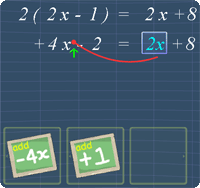
Next example on solving linear equations, let's solve 2(2x -1) = 2x +8.
00:02:01.150
First, we need to remove the brackets.
00:02:07.180
2 multiply by 2x gives +4x. 2 multiply by -1 gives negative 2. Now, let's put these terms back into the equation.
00:02:22.220
Now, we can remove 2x by adding -2x to both sides of the equation.
00:02:31.220
This gives +4x -2 -2x = +8.
00:02:38.040
Now, we can remove -2 by adding +2, to both sides of the equation.
00:02:46.110
This gives +4x -2x = +8 + 2.
00:02:52.090
We can simply this equation by adding 4x and -2x . This gives +2x.
00:03:03.000
Now, add +8 with +2. This gives +10.
00:03:09.000
To find x, we need to remove +2 from +2x. We can do so by dividing both sides of the equation by +2.
00:03:15.010
The equation becomes x = +10/+2. Now, we divide +10 with +2. This gives 5.
00:03:33.060
So, the answer is x = 5.
00:03:38.100
Next example on solving linear equations. Let's solve. 2 (x +1) = 5 – 3(x -1).
00:03:46.100
First, we need to remove the brackets in this equation. Let's start with 2 bracket x+1.
00:03:55.000
2 multiply by x gives 2x. 2 multiply by +1 gives +2. Let's put these terms back.
00:04:07.240
Now, let's remove the brackets in -3(x -1).
00:04:15.080
-3 multiply by x gives -3x. -3 multiply by -1 gives +3. Let's put these terms back.
00:04:30.100
Now, we need to remove -3x from the Right Hand Side. To do so, we add +3x to both sides of the equation.
00:04:41.230
By doing so, the equation becomes 2x +2 +3x = 5 +3.
00:04:49.160
We can remove +2 by adding -2 to both sides of the equation. The equation now becomes 2x +3x = 5 +3 -2.
00:05:04.010
Now, we simplify the equation by adding 2x with 3x. This gives +5x
00:05:12.100
3 minus 2 gives 1. 5 plus 1 gives 6.
00:05:19.090
Now, to get x, we need to remove +5. We can do so by dividing +5 to both sides of the equation.
00:05:31.100
This gives, x = +6 / +5.
00:05:38.110
Now, since 6 divides by 5 is not an integer, we can leave the answer in the form of fraction.
00:05:45.120
So, the answer is x = 6/5.
00:05:52.140
Final example on solving linear equations, let's simplify x/4 + 2 = x -1.
00:05:59.130
Now, we can remove +2 by adding -2 to both sides of the equation.
00:06:07.010
The equation now becomes, x/4 = x -1 -2.
00:06:13.220
Now, we can add -1 and -2. This gives -3.
00:06:19.190
It is easier to solve this equation if we remove the denominator, 4, from this equation.
00:06:27.110
We can do so by multiplying both sides of the equation by 4.
00:06:33.110
The equation now becomes x = 4(x -3). Remember to put brackets around the terms when multiplying.
00:06:42.230
To proceed, we need to remove these brackets.
00:06:48.080
4 multiply by x gives 4x. 4 multiply by -3 gives -12. Let's put back these terms.
00:07:01.040
We can remove 4x by adding both sides of the equation by - 4x. This gives x -4x = -12.
00:07:12.160
Now, we can simplify the equation by adding x with -4x. This gives negative 3x.
00:07:21.230
To get what is x equals to, we need to remove -3 from -3x.
00:07:27.190
To do so, we divide both sides of the equation by -3.
00:07:35.070
The equation now becomes, x = -12/ -3.
00:07:41.060
Dividing -12 with -3 gives 4 . So, the answer is x = 4.
00:07:49.000
That is all for this lesson on on solving linear equations. Try out the practice questions to reinforce your understanding.
Practice Questions & More

Multiple Choice Questions (MCQ)
Now, let's try some MCQ questions to understand this lesson better.
You can start by going through the series of questions on solving linear equations or pick your choice of question below.
- Question 1 on the basics on solving linear equations
- Question 2 on the basics on solving linear equations

Site-Search and Q&A Library
Please feel free to visit the Q&A Library. You can read the Q&As listed in any of the available categories such as Algebra, Graphs, Exponents and more. Also, you can submit math question, share or give comments there.
